40-Gallon vs. 50-Gallon Water Heater: Which Size Is Right for Your Utah Home?
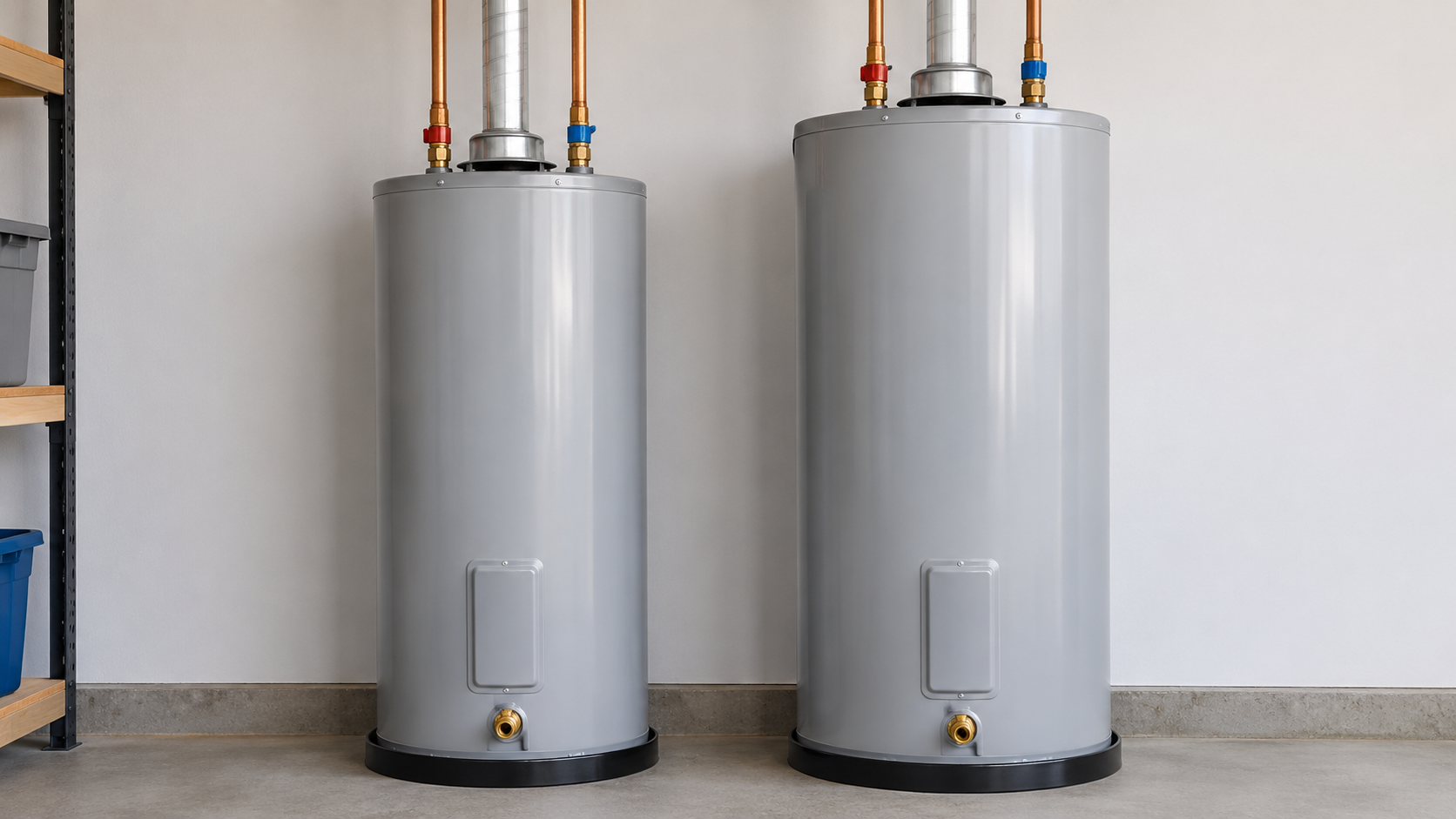
Choosing between a 40-gallon and 50-gallon water heater is not simply a matter of picking the larger tank. The right size depends on how many people live in your home, when your household uses hot water, and how much hot water is needed during the busiest part of the day.
For many Utah homeowners, both 40- and 50-gallon water heaters can be practical options. A 40-gallon unit may be enough for a smaller household with moderate hot-water demand, while a 50-gallon water heater can provide additional stored hot water for homes where showers, laundry, dishes, and other uses frequently overlap.
APS Plumbing installs residential water heaters throughout Utah’s Wasatch Front and can help homeowners evaluate the appropriate size and system for their home.
40-Gallon vs. 50-Gallon Water Heater: What Is the Main Difference?
The basic difference is storage capacity.
A 40-gallon water heater stores approximately 40 gallons of heated water, while a 50-gallon model stores approximately 50 gallons.
That extra 10 gallons can matter when several people need hot water within a short period. However, tank capacity is only one part of water-heater performance. Recovery rate, fuel type, first-hour rating, and household usage patterns also affect how much hot water is available when you need it.
This is why replacing an existing tank with the same gallon size is not always the only option worth considering.
Who May Be a Good Fit for a 40-Gallon Water Heater?
A 40-gallon water heater can make sense for households with relatively moderate hot-water demand.
It may be worth considering when:
- Fewer people live in the home
- Hot-water use is spread throughout the day
- Multiple showers are not usually happening back-to-back
- Laundry, dishes, and showers are not commonly running at the same time
- The existing 40-gallon system has consistently met the household’s needs
If your current 40-gallon water heater has provided enough hot water without frequent shortages, another properly sized 40-gallon unit may continue to meet your needs.
When Does a 50-Gallon Water Heater Make More Sense?
A 50-gallon water heater provides additional stored hot water and may be useful when household demand is higher.
A homeowner may want to consider a 50-gallon system when:
- Several people live in the home
- Multiple showers happen close together
- Hot water is frequently used in several places at once
- Laundry and dishwashing regularly overlap with showers
- The current water heater frequently runs short of hot water
- Household hot-water needs have increased since the existing heater was installed
The additional capacity does not automatically make a 50-gallon unit the right choice for every home. The water heater still needs to match the home’s fuel source, available installation space, plumbing setup, and actual hot-water demand.
APS Plumbing’s water heater installation services can help homeowners determine which option better fits their property and usage.
Household Size Is Helpful, but Hot-Water Demand Matters More
Household size is a useful starting point, but two households with the same number of people can have very different hot-water needs.
Consider two four-person households.
In one home, showers happen at different times of the day and laundry is usually done later. In the other, several people shower during the same hour while the dishwasher or washing machine is also running.
The second household creates much greater peak demand even though both homes have four occupants.
When comparing 40- and 50-gallon water heaters, think about your household’s busiest hour rather than just the number of people living in the home.
Questions worth asking include:
- How many showers normally happen within one hour?
- Does someone frequently run laundry while another person showers?
- Is the dishwasher commonly running during peak hot-water use?
- Are there multiple bathrooms being used at the same time?
- Does the existing water heater regularly run out of hot water?
Those answers give a plumber much more useful information than household size alone.
What Is a Water Heater’s First-Hour Rating?
The first-hour rating, often abbreviated FHR, estimates how much hot water a storage water heater can provide during a high-demand hour when starting with a fully heated tank.
This number can be more useful than tank capacity alone.
For example, two 50-gallon water heaters may not necessarily deliver identical first-hour performance. Recovery rate and other equipment characteristics can affect how quickly heated water becomes available after some of the stored supply has been used.
When choosing a replacement water heater, matching the system to your expected peak demand can help avoid selecting a tank that is unnecessarily large or one that regularly cannot keep up.
Should You Upgrade From 40 Gallons to 50 Gallons?
Sometimes.
Moving from a 40-gallon water heater to a 50-gallon model may make sense if your household has grown or you regularly experience hot-water shortages.
But increasing tank size should not be automatic.
Before changing sizes, consider:
- Whether the current tank actually runs out of hot water
- Whether household demand has increased
- Whether the installation area has enough room for the new unit
- Whether the existing connections are appropriate for the replacement
- The first-hour rating of the water heater being considered
- Whether a different type of water heater would better match the home
The goal is not to install the largest tank possible. The goal is to install a water-heating system that appropriately supports the household.
What If Neither a 40- nor 50-Gallon Tank Seems Ideal?
A traditional storage-tank water heater is not the only option.
Some homeowners may want to consider a tankless water heater.
Instead of storing a fixed amount of heated water, a tankless unit heats water as it flows through the system. This changes the sizing question from tank capacity to factors such as flow rate and temperature rise.
Tankless systems can also save floor space because they are generally wall-mounted. However, converting from a storage tank to tankless can involve different installation requirements, so it should be evaluated based on the home’s existing plumbing and utility setup.
APS Plumbing installs both traditional tank and tankless water heaters and can help determine which type makes sense for the property.
Does a Bigger Water Heater Mean Better Performance?
Not necessarily.
A larger tank gives you more stored hot water, but bigger is not automatically better.
Installing more capacity than a household needs can take up additional space and may not provide a meaningful benefit if the smaller system already handles normal demand.
At the same time, choosing a unit that is too small can result in frustrating hot-water shortages.
Proper sizing means balancing available capacity with actual household demand.
Questions to Ask Before Replacing Your Water Heater
Before choosing between a 40- and 50-gallon water heater, it helps to gather a few details about your current system and household.
How large is the existing water heater?
Look for the manufacturer label on the tank. It normally lists the rated storage capacity.
Does the current system regularly run out of hot water?
If not, the existing capacity may already be appropriate.
Has the household changed?
More occupants or different schedules can increase demand.
When is hot-water use highest?
Think about showers, laundry, dishwashing, sinks, and other hot-water uses happening within the same hour.
Are you interested in staying with a tank or considering tankless?
Your replacement project may be an opportunity to compare both approaches.
For broader household plumbing needs, APS Plumbing also provides residential plumbing services throughout Utah’s Wasatch Front.
40-Gallon vs. 50-Gallon Water Heater FAQs
Is a 40-gallon water heater enough for a family?
It can be. A 40-gallon water heater may work well for households with moderate hot-water demand, but household size alone does not determine the correct capacity. Peak-hour hot-water use and the unit’s first-hour rating should also be considered.
Is a 50-gallon water heater better than a 40-gallon?
Not automatically. A 50-gallon water heater stores more hot water, which can help households with greater demand. A 40-gallon system may be sufficient when hot-water usage is lower or more spread out.
Can I replace a 40-gallon water heater with a 50-gallon model?
In some homes, yes. The replacement still needs to fit the available space and be compatible with the home’s plumbing, fuel source, venting, and other installation requirements. A plumber can evaluate the existing setup before recommending a change in capacity.
Why does my water heater run out of hot water?
Running out of hot water can be related to household demand, tank capacity, recovery rate, equipment condition, or another issue with the system. The cause should be evaluated before assuming that a larger water heater is required.
Should I choose a tankless water heater instead?
Tankless may be worth considering if you want an on-demand system or need to save floor space. The appropriate choice depends on household hot-water demand and the existing plumbing and utility setup.
Need Help Choosing a Water Heater?
APS Plumbing provides water heater installation and tankless water heater installation for homeowners across Utah’s Wasatch Front.
If you are deciding between a 40-gallon, 50-gallon, or tankless system, APS Plumbing can help you evaluate your household’s hot-water needs and the existing plumbing setup.
Call 385-226-6795 to discuss your water-heater installation needs.